

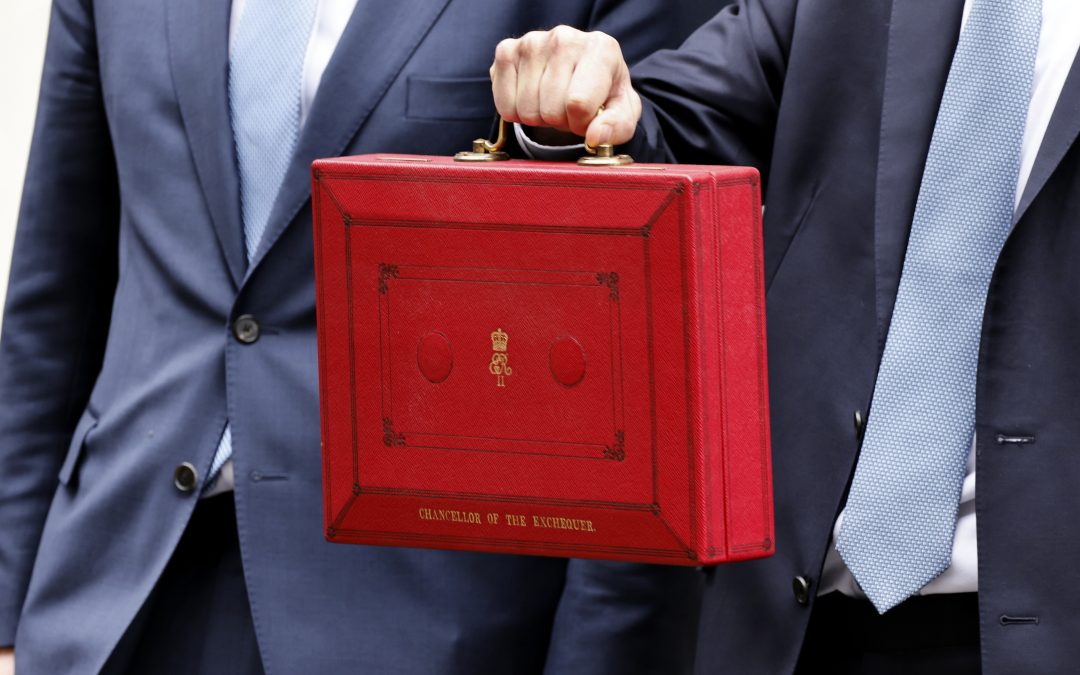
Most Budget coverage this week has been about tax rates, and understandably so. But buried in the detail was a measure that will matter more to British manufacturers than any of the headline numbers, and it has had almost no attention.
The Chancellor announced a new definition of a British supplier for public procurement purposes, so that preferential treatment goes to firms creating genuine investment and jobs in the UK.
On the face of it, that is a technical adjustment to procurement guidance. In practice it is the point at which a phrase that has been used loosely for years starts to carry a test behind it. And for those of us who have been manufacturing here for decades, that is a welcome change.
Before going further, the usual caveat. We manufacture labels, not tax advice. What follows is a summary of what was announced and why we think it matters to the sectors we work in. For anything affecting your own position, speak to your accountant.
What Was Actually Announced
The measure sits within a wider push to make public procurement easier for smaller firms to access. The reasoning is that the preferential treatment intended for British businesses has not always reached the businesses doing the work in Britain, because the label has been easy to claim and hard to verify.
It did not appear from nowhere. Procurement policy has been moving in this direction throughout 2026. Guidance issued in June directed government departments to use existing powers under the Procurement Act 2023 to support critical UK capabilities in sectors including steel. Further guidance in August simplified bidding for contracts up to £1 million to open them to smaller suppliers. The Budget measure is the next step in the same sequence.
What Makes a Business British
This is the part worth paying attention to, because it changes what evidence a supplier may need to put forward.
Make UK, the manufacturers’ organisation, had argued through 2026 for a more robust definition of a UK-based business, one considering factors such as employment, manufacturing activity, R&D, tax contribution, operational footprint and IP creation in the UK. The intention is to distinguish between a company that genuinely builds things here and one that has a registered office here and very little else.
The exact wording will emerge in guidance rather than in the Budget speech, and it is worth watching for anyone who bids for public work. But the direction is clear enough. A British supplier is increasingly going to mean one that can demonstrate where its people are, where its production happens and what it contributes, rather than one that simply says so.
It is also worth saying what this is not. Make UK was explicit that the objective should not be to restrict competition or exclude international suppliers, and the UK remains bound by international procurement obligations including the WTO Agreement on Government Procurement. This is about defining a preference properly, not closing a market.
Nearly Thirty Years of Answering That Question
We have a particular interest in this, because it is a test we have been able to pass since 1997.
Custom Labels has manufactured labels and asset tags at our facility in Bridgwater, Somerset since June 1997, which makes this our twenty-ninth year. Everything is produced in house. Our print, finishing, quality control and sales team are all under one roof in Somerset, and the people who answer your call are in the same building as the press that makes your labels.
That matters commercially, and it always has. UK manufacturing means shorter lead times, with most orders dispatched in three to five working days from artwork approval. It means a supplier you can reach when something needs resolving, in your own time zone, with the ability to see the job. And it means quality you can verify, under ISO 9001 and ISO 14001 accreditation, with every order inspected before dispatch and anything falling short remade rather than passed with a note.
We are also proud members of Made in Britain, which has never been a marketing badge for us so much as a statement of where the work happens.
Over that time we have supplied organisations across the most demanding sectors in the country. In defence, the Ministry of Defence, BAE Systems, Babcock and Serco. In energy, EDF and British Gas. In infrastructure and construction, Balfour Beatty, Kier, BAM, Murphy and Network Rail. Beyond engineering, names including Barbour, JLR, McLaren, British Airways, the BBC and the Co-op.
Many of those organisations sit inside public sector or regulated supply chains, where questions about provenance are already routine. What the Budget measure does is make those questions more common, and make the answers count for more.
The Second Measure: Capital Allowances
The other announcement relevant to anyone who buys equipment concerns how that purchase is relieved.
Full expensing continues, and the main-rate first-year capital allowance rises from 40% to 50% for qualifying expenditure from January 2027. At the same time, the main rate of writing down allowances falls from 14% to 12% from April 2027, having already dropped from 18% to 14% in April 2026.
Taken together, relief is being pulled forward. More of the benefit now lands in the year of purchase, and less of it trickles out across the years that follow.
For most businesses that is welcome. It does, however, put more weight on getting the record right at the point of acquisition, because the year you claim is the year that matters, and a claim is only as good as the evidence sitting behind it.
Where This Lands for Asset Records
This is the part of the story we see from where we sit.
An asset register is the evidence base for a capital allowance claim. When relief is spread thinly over many years, a register that has drifted slightly is an irritation. When relief is concentrated in year one, and when disposals have to be accounted for accurately against what was claimed, the same drift becomes a problem.
The common failure is not dishonesty. It is ghost assets, which are items still sitting on the register that were sold, scrapped or quietly lost without the record being updated, and the reverse case of equipment in daily use that was never recorded at all. Industry estimates suggest that between 10% and 30% of business assets can drift into that state without active management.
Whatever system you use to track them, the link between the physical item and its record is a label. If that label has faded, peeled or become unreadable, the item is effectively untracked no matter how good the software is. It is the least glamorous part of asset management and the part everything else depends on.
Why the Procurement Change Is the Bigger Story
The capital allowance measures will be picked over by every accountancy firm in the country this week. The supplier definition will not, and for British manufacturers it is the more consequential of the two.
For years, UK manufacturing has been a claim that was cheap to make. A defined test changes that, and it changes it in favour of businesses who can answer the question properly. If you supply into public sector contracts, it is worth being able to evidence where your own supply chain sits, because that question is going to be asked more often.
We have been giving the same answer to it for twenty-nine years.
Frequently Asked Questions
What is the new British supplier definition? It is a definition announced in the Autumn Budget 2026 for public procurement purposes, intended to ensure preferential treatment goes to firms creating genuine investment and jobs in the UK rather than those with only a nominal UK presence. Detailed guidance is expected to follow.
Does this mean overseas suppliers are excluded from UK public contracts? No. The stated aim is to define a preference more accurately, not to restrict competition, and the UK remains bound by international procurement agreements including the WTO Agreement on Government Procurement.
Are Custom Labels a UK manufacturer? Yes. We have manufactured labels and asset tags in Bridgwater, Somerset since June 1997, with all production in house, ISO 9001 and ISO 14001 accreditation, and membership of Made in Britain.
What changed with capital allowances in the Autumn Budget 2026? Full expensing continues, the main-rate first-year allowance rises from 40% to 50% from January 2027, and the main rate of writing down allowances falls from 14% to 12% from April 2027. Speak to your accountant about how this affects your own position.
Why does a capital allowance claim depend on an asset register? The register is the evidence base. It records what was bought, when, at what value, and what happened to it afterwards, which is what supports both the original claim and any later disposal.
What is a ghost asset? A ghost asset is an item that still appears on your asset register but no longer exists, having been sold, scrapped, lost or stolen without the record being updated. Estimates suggest 10% to 30% of business assets can drift into this state without active management.
If you are reviewing how your assets are tracked, or you need labels and tags manufactured in the UK by a supplier who can evidence it, our team is happy to help. Call 01278 433800, email sales@customlabels.co.uk, or order a sample pack.
Recent Comments