

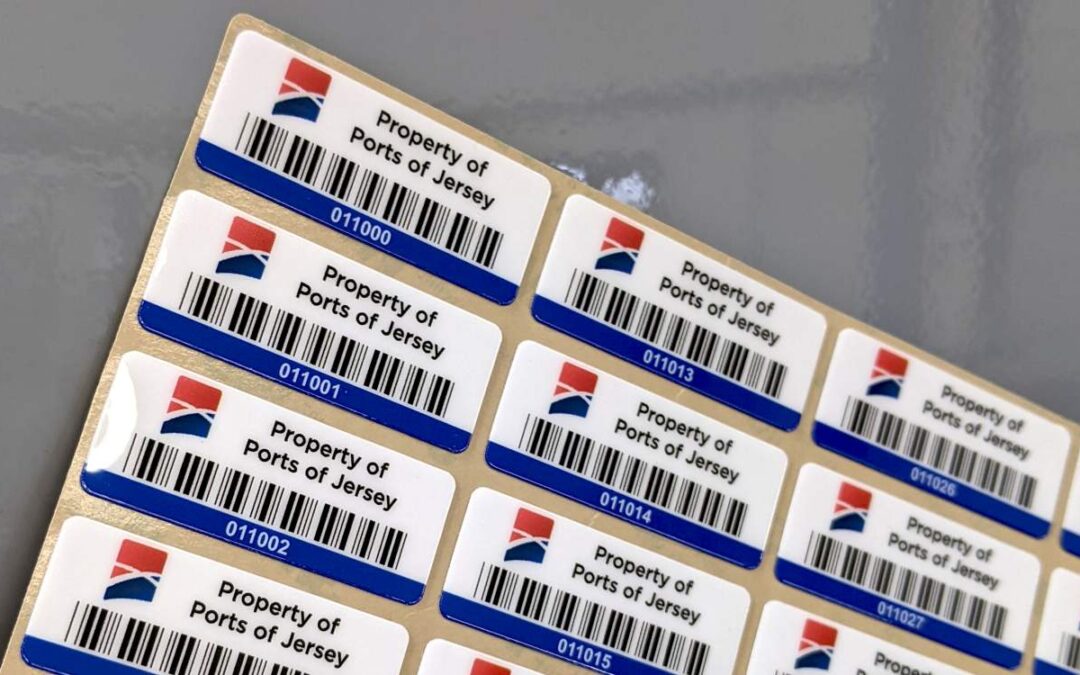
Asset management systems are often judged by software, processes, and reporting. Yet one of the most critical components is also the easiest to overlook: the asset label itself.
When asset labels perform as they should, they fade into the background. They remain legible, attached, and accurate year after year. It is only when they fail that their importance becomes obvious.
A serial number that can no longer be read. A barcode that won’t scan. A label that peels away long before the asset reaches the end of its working life. At that point, even the most carefully maintained asset register begins to lose its value.
Asset Labels Are the Physical Link Between Assets and Data
At their core, asset labels exist to connect physical equipment to records. They transform an item from something that is simply “there” into something that is identifiable, traceable, and accountable.
In practice, asset labels quietly support audits, maintenance schedules, servicing histories, ownership tracking, and regulatory compliance. They are not the system themselves, but they are the most visible and frequently used access point to it.
When labels fail, the impact is rarely isolated. Time is lost identifying equipment, records drift out of sync, and confidence in the asset management process begins to erode.
Most Asset Label Failures Start Before Purchase
It is easy to assume that label problems stem from manufacturing issues. In reality, most failures originate much earlier, at the point of specification.
Too often, asset labels are chosen based on appearance, price, or generic descriptions rather than real-world use. The more important considerations are environmental and practical.
Where will the asset be used? What surface will the label be applied to? How long is it expected to remain in place? Will it be exposed to cleaning chemicals, abrasion, heat, or ultraviolet light?
Once these questions are answered, selecting the appropriate material and adhesive becomes far more straightforward. Without them, even a well-made label can fail prematurely.
Asset Labels vs Asset Tags: Performance Over Terminology
The terms “asset label” and “asset tag” are frequently used interchangeably, which can cause confusion. In reality, the terminology matters far less than how the label performs in its intended environment.
A label that stays securely attached, remains readable, and carries accurate data will always outperform one that is marketed well but poorly specified. Names and product descriptions do not protect assets. Materials, adhesives, and data integrity do.
Durability Is the Result of Multiple Factors
Durability is often presented as a single feature, but in practice it is a system of interdependent elements.
Material choice influences resistance to abrasion, chemicals, and impact. Adhesive selection determines whether a label will remain bonded to a surface over time. Print protection affects legibility, particularly in outdoor or industrial environments. Environmental exposure, including UV light and temperature extremes, further shapes long-term performance.
Labels described as “heavy duty” or “industrial” should always be supported by clear material and performance specifications. Without them, durability claims are difficult to assess.
Variable Data Is Where Many Systems Break Down
Variable data is what gives asset labels their value. Serial numbers, barcodes, QR codes, and DataMatrix codes allow each asset to be uniquely identified and linked to its record.
However, data handling is also where many asset labelling systems encounter problems. Duplicate identifiers, inconsistent formats, or rushed data preparation can undermine tracking accuracy very quickly.
Once trust in the data is lost, the label itself becomes far less useful. Effective asset labelling relies as much on disciplined data management as it does on physical label construction.
Speed Versus Accuracy in Asset Labelling
Fast turnaround times are appealing, particularly when assets need to be deployed quickly. Same-day or next-day dispatch can be useful, but speed should never come at the expense of accuracy or quality control.
A label that fails early does not simply need replacing. It introduces downtime, creates confusion, and often requires additional administrative effort to correct records. In many cases, investing a little more time upfront results in far greater efficiency over the life of the asset.
The Best Asset Labels Are the Ones You Never Notice
The most effective asset labels rarely attract attention. They do not peel, fade, or fail. They remain in place, readable and reliable, quietly supporting asset management systems for years at a time.
When labels are correctly specified, manufactured, and applied, no one talks about them. In asset management, that silence is usually the clearest indicator that everything is working exactly as it should.
With over 27 years of UK manufacturing experience, Custom Labels Ltd designs and produces high-performance asset labels built to perform in real-world environments. By combining material expertise, controlled production, and rigorous quality checks, the focus remains on labels that support long-term asset management rather than drawing attention to themselves.
Contact our team for expert advice, samples, or a fast quotation, and explore how Custom Labels Ltd supports long-term asset identification with durable labels and tags.
Recent Comments