


Back in January 2024, we covered the UK government's announcement that it would allow digital labelling on a range of imported goods. That announcement has since become live legislation, and a consultation published in March 2026 sets out exactly what information can move online and what has to stay on a physical label. Here's where things stand as of mid-2026, and what it means if you're currently labelling products or assets.
A quick recap: where we left off in 2024
In our original post, we reported that the Department for Business and Trade had completed its Product Safety Review and proposed allowing British businesses to provide manufacturing information digitally, as an alternative to a physical label, for certain imported goods. At the time, this was policy intent rather than law, sitting alongside continued UK recognition of CE marking next to the newer UKCA standard.
The law behind it: the Product Regulation and Metrology Act 2025
On 21 July 2025, the Product Regulation and Metrology Act received Royal Assent. This Act doesn't spell out the detailed rules itself. Instead, it hands the Secretary of State the power to make new product safety and metrology regulations, including on digital labelling, through secondary legislation. It's the legal mechanism that turns the 2024 announcement into something that can actually be enforced, and the government has now started using it.
The March 2026 consultation: "digital by default"
On 31 March 2026, the Department for Business and Trade and the Office for Product Safety and Standards launched a consultation on a new core product safety framework, intended to replace the General Product Safety Regulations 2005. Alongside proposals covering online marketplaces, AI enabled products and enforcement powers, the consultation set out a "digital by default" approach to product labelling.
Under the proposal as it currently stands:
- Certain identifiers, such as serial numbers and batch numbers, would still need to appear physically on the product or its packaging.
- Other information, including safety instructions, warnings and producer contact details, could be provided digitally instead, for example through a QR code or NFC tag, as long as no sector specific rule requires it to be physical.
- Where digital delivery is used, the physical label still needs to make clear what information is available digitally, and safety information must be clearly flagged as needing to be read before use.
- Consumers keep the right to request a physical copy of safety information.
The consultation closed on 23 June 2026. Government has committed to publishing a joint response within 12 weeks of that date, which points to around September 2026, followed by secondary legislation under the 2025 Act and implementation guidance for businesses.
What has to stay physical vs what can go digital
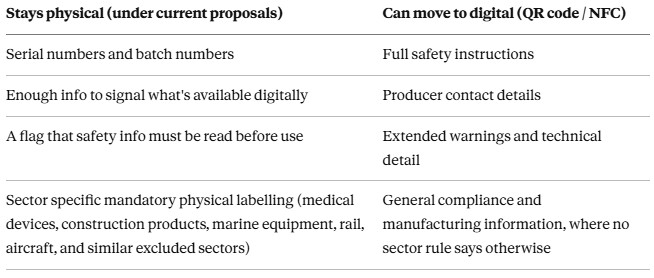
This is based on the current consultation proposals, not final regulations, so treat it as the direction of travel rather than confirmed law.
What this means if you're labelling products or assets right now
For manufacturers and importers, the direction of travel is clear even before the final rules land. Digital delivery is coming for warnings, instructions and contact details, but identifying information stays physical, and a physical label or tag is still required as the gateway to everything else. In practice, that means the opportunity isn't "remove the label." It's "make sure the physical label is durable and reliable enough to keep pointing to the digital content for the working life of the product."
That's exactly where QR and barcode labels, NFC enabled asset tags and durable graphic overlays come in. As sector specific rules are phased in over the next few years, expect more physical labels to carry a scannable code linked to hosted compliance and safety information, alongside whatever minimum physical text is mandated. A label or overlay that fades, lifts or becomes unreadable defeats the point of the whole system, so material choice and print durability matter as much under this new approach as they did under the old one, arguably more, since the physical label is now carrying the weight of directing users to everything else.
FAQ
Is UK digital labelling law already in force? Not yet in full. The enabling legislation, the Product Regulation and Metrology Act 2025, is in force, but the specific digital labelling rules are still working through consultation and will be introduced through secondary legislation.
What has to stay on a physical label under the new UK proposals? Identifiers such as serial numbers and batch numbers, plus enough information to show what else is available digitally, would need to remain physical under the current proposals.
Can safety warnings be provided online only? Only where no sector specific rule requires them physically. Even then, the physical label must flag that safety information needs to be read before use, and consumers retain the right to request a physical copy.
When will the new UK digital labelling rules take effect? The consultation closed on 23 June 2026. A government response is expected around September 2026, followed by secondary legislation and an implementation period, so an exact effective date hasn't been confirmed yet.
Does this affect medical devices, construction products or rail equipment? These sectors, along with marine equipment, cableways, transportable pressure equipment and unmanned aircraft systems, are largely excluded from the general digital labelling proposals and continue to be handled through their own sector specific regulations.
Custom Labels: ready for whichever way this lands
Whatever the final rules say, physical labels aren't going away, they're changing role. Our QR and barcode labels, NFC asset tags and under surface printed graphic overlays are built to survive the harsh environments and long product lifespans this legislation is designed around, with chemical, UV, sea water and scratch resistance backed by premium 3M adhesive.
Speak to our sales team today on 01278 433800 or email sales@customlabels.co.uk for samples, a quote or advice on preparing your labelling for the digital by default transition.
Recent Comments