

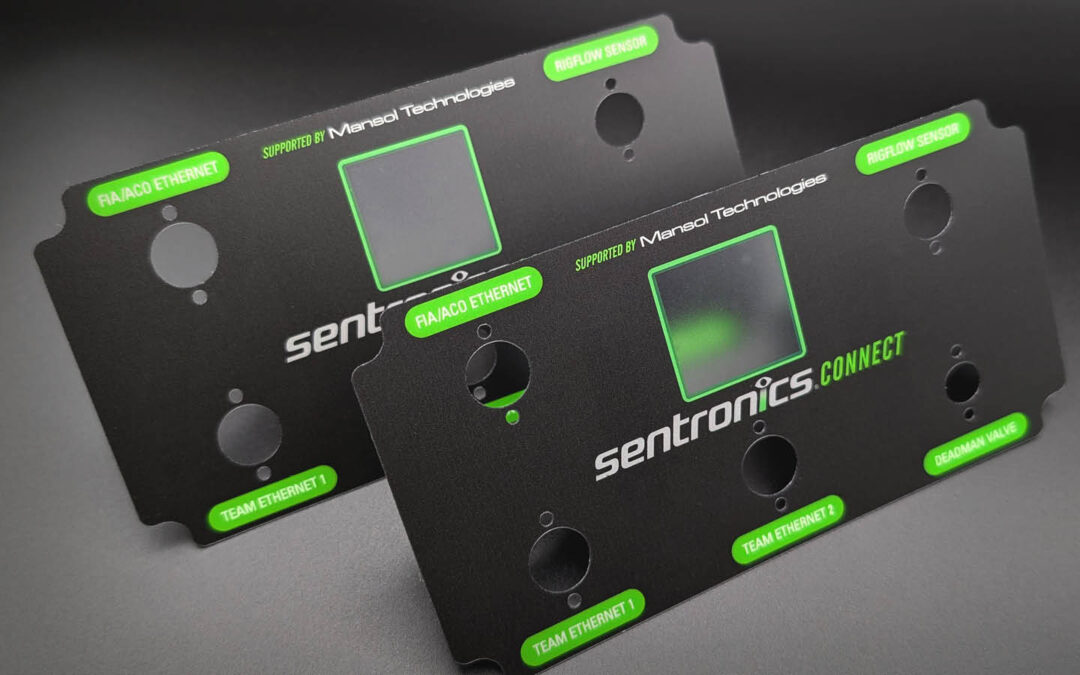
We recently updated our graphic overlays and control panel labels page, and it prompted us to write something that goes a little deeper not as a substitute for reading the page, but as a companion to it.
Graphic overlays are one of those products where the decisions involved are less obvious than they first appear. Customers often come to us knowing roughly what they need, a professionally finished front panel for a piece of equipment but uncertain about materials, printing methods, quantities, or how the process actually works. This post is for those customers.
Why Printing Method Matters More Than You Might Think
Most people ordering a graphic overlay for the first time are understandably focused on how it looks. Colour accuracy, finish, and layout are all important, but the printing method shapes something more fundamental: how the overlay holds up over time.
Our overlays are produced using digital printing and under-surface printing. The two work together. Under-surface printing means the graphics are applied to the reverse of the overlay material, with the clear face of the substrate sitting on top as a protective layer. The ink never touches the outside world it sits behind the material, fully encapsulated. That single characteristic is what makes our overlays genuinely resistant to scratching, chemical cleaning, abrasion, and UV exposure, not as a marketing claim but as a practical consequence of how they're built.
Digital printing removes the need for physical plates entirely. In traditional screen or flexographic printing, plates are created for each colour and each design before a single print run can begin. Those plates carry a cost, and that cost has to go somewhere. With digital printing, artwork goes straight from file to output. No plates, no tooling, no setup charge tied to your design.
The Practical Difference for Your Project
The most immediate effect customers notice is on prototyping. Under conventional plate-based printing, producing a prototype costs almost as much as producing a full run, because the setup process is the same regardless of quantity. That makes genuine design iteration expensive, and in practice it tends to compress the review process in ways that don't always serve the final product.
Because we use digital printing, prototyping is straightforward. You can order a small number of overlays to test against your hardware, checking fit, finish, colour, and tactile response before committing to volume. If something needs adjusting, you update the file and reprint. There is no penalty for getting to the right answer through a few iterations.
Equally, there are no minimum order quantities. That matters across the full range of what our customers do. For a business developing a new product, it means you can prototype properly without over-ordering. For an OEM managing multiple product variants, it means you can order precisely what each variant requires rather than consolidating runs to make the economics work. For a manufacturer producing a mature, high-volume product, the same digital process scales to large runs with consistent quality throughout.
What Goes Into a Graphic Overlay
The materials and features available for each overlay are covered in full on our graphic overlays and control panel labels page, so we won't repeat all of that here. What's worth understanding is that the material choice, finish, cut-out configuration, button type, and window specification all interact and getting that combination right for your specific application is where most of the meaningful work happens.
Our team works through those decisions with customers as part of the quoting process, and we can develop artwork from scratch if you come to us without a finished design.
The Control Panel Side of Things
Control panel labelling sits slightly differently from graphic overlays in terms of application, though the manufacturing process is the same. A well-marked control panel is an operational and safety asset. Breakers, push buttons, isolators, and terminals that are clearly and permanently identified reduce fault-finding time, support safe working, and hold up to the kind of cleaning schedules that industrial environments typically demand.
The durability characteristics that make our overlays suitable for product interfaces chemical resistance, UV stability, resistance to abrasion apply equally here. A control panel label that fades, peels, or becomes illegible after a year of service is a problem that compounds over time. Getting it right from the start is the better outcome for everyone.
A Note on Quality
Everything we produce is manufactured at our UK facility in Bridgwater under our ISO 9001 Quality Management System. We also hold ISO 14001 accreditation for environmental management and an EcoVadis Bronze Sustainability Rating. If an order doesn't meet our standards, we remake it before it leaves the building.
If You're Considering a Graphic Overlay Project
The best starting point is usually a conversation or a sample request. We can send a graphic overlay sample booklet so you can evaluate our materials and finishes before committing to anything. If you have drawings or artwork ready, we can turn a quotation around quickly. If you're earlier in the process and still working through specification, our team is well-placed to help you think it through.
You can find full details on our graphic overlays and control panel labels page, request a sample booklet there, or reach us directly on 01278 433800 or at sales@customlabels.co.uk.
Recent Comments