

If you are about to run your first proper physical audit of your organisation’s assets, here is what to expect. It will turn up more discrepancies than you think it should. That is not a sign anything has gone wrong. It is the entire point of doing it.
Almost every organisation running its first audit finds a meaningful gap between what the records say and what is actually sitting in the building. Industry estimates suggest somewhere between 10% and 30% of business assets can drift out of sync with the register over time, present physically but never logged, or logged but no longer there. If your first count turns up more of these than you expected, that is the audit working, not the audit failing.
Step 1: Compile a starting list
Pull together everything you already have. Purchase records, invoices, existing spreadsheets, whatever the current system amounts to. Do not worry about how messy or incomplete it is at this stage. This list is your baseline, not your final answer.
Step 2: Walk the floor
Physically go through every relevant space and locate assets. There is no shortcut here for a first audit. This is the step that actually tells you what is true. Manually cross referencing serial numbers against a spreadsheet is slow, but for a first pass it is the only way to establish ground truth before you can rely on anything faster, such as scannable labels.
Step 3: Reconcile
Two lists will emerge. Items that appear in your records but were not physically found, which may have been disposed of, lost, stolen, or quietly transferred without paperwork. And items that were physically found but do not appear anywhere in your records, because nobody logged them in the first place.
The size of that gap is your count of untracked assets. This is the number that matters. Addressing it properly, once, is far less expensive than carrying the problem forward year after year.
Step 4: Apply labels on the spot
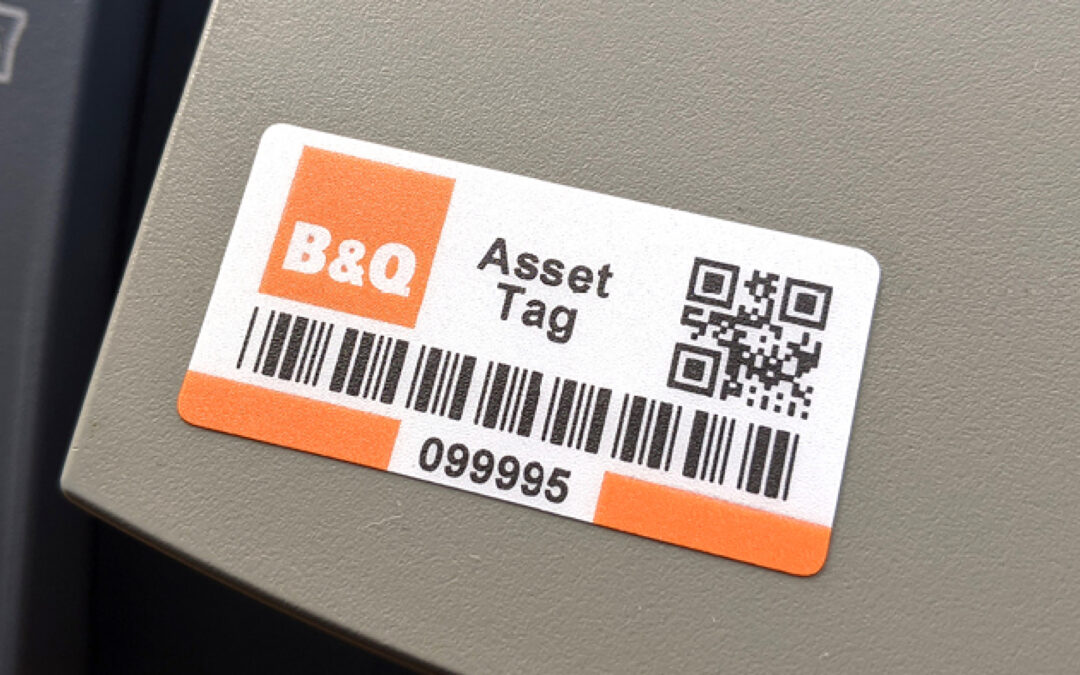
As you go, label everything you have identified there and then. Do not leave this for a follow up visit. Items that get walked past twice have a habit of not getting labelled at all. If you are weighing up an asset label against an asset tag for different item types, the short version is that internal, low wear items suit a standard label, while anything facing UV exposure, chemical contact, or physical impact needs a more durable tag construction. Our team can talk you through the options if you are not sure.
Step 5: Photograph each labelled asset against its record
A photo taken at the point of labelling does two things. It gives you a visual record for insurance and disposal purposes later, and it catches labelling errors immediately. A mismatched serial number or a label applied to the wrong item is far easier to fix on the spot than three years later.
Step 6: File the paperwork against the register entry
Wherever you can trace it, attach the original invoice or purchase record to the register entry. For items where no documentation exists, register them anyway with the best description available and a note that the acquisition history is unknown. An imperfect record beats no record.
What good looks like afterwards
Once the first audit is done, the job shifts from discovery to maintenance. An annual full audit is the minimum for most regulated environments, but rolling cycle counts, where you audit roughly 10% of the estate each month, catch problems earlier and cause far less disruption than a single annual scramble. High value, portable, or frequently relocated assets are worth checking more often than that baseline regardless of schedule.
It is also worth deciding, before you start, who actually owns this process going forward. The most common cause of a register slowly falling apart is not bad software or a bad numbering scheme. It is ambiguous ownership. Finance owns the financial register, IT owns the laptops, operations owns the plant, and nobody owns the register as a whole. Naming a single owner, typically facilities, operations, or finance, with a named deputy, and giving them explicit responsibility for accuracy, does more for long term reliability than any tool you buy.
A note on items you cannot resolve neatly
Not every discrepancy has a tidy answer. For items you find but cannot trace back to a purchase record, register them anyway with a note that the acquisition history is unknown. Do not leave them unlabelled just because the paper trail is incomplete. For items on the register that you cannot locate, do not simply delete them. Retire the record with a note of what you believe happened and when. A written off record with reasoning attached is worth far more at your next audit, or at insurance claim stage, than a silent deletion.
Frequently asked questions
How many discrepancies should I expect on a first audit? There is no universal number, but industry estimates suggest 10% to 30% of business assets can be out of sync with the register in organisations that have never run a formal audit. Finding discrepancies in that range is normal and expected, not a cause for concern.
What is a ghost asset? A ghost asset is an item still listed on the register that no longer physically exists, because it was sold, scrapped, lost, or stolen without the record being updated. The same term is sometimes used the other way round, for items that physically exist but were never added to the register.
Do I need special equipment to run an asset audit? No. A first audit can be run with a spreadsheet, a clipboard or tablet, and a supply of asset labels. Scannable barcode or QR labels make future audits faster, but they are not required to complete the first one.
How often should audits happen after the first one? An annual full audit is the minimum in most regulated environments. Many organisations run rolling cycle counts instead, checking around 10% of the estate each month, which spreads the workload and catches problems sooner.
Who should own the asset register? A single named owner, usually in facilities, operations, or finance, with a named deputy. Shared or unclear ownership is the most common reason asset registers fall out of date.
If you are planning a first audit and want to talk through labelling options before you start, get in touch with our team or call us on 01278 433800.
Recent Comments