

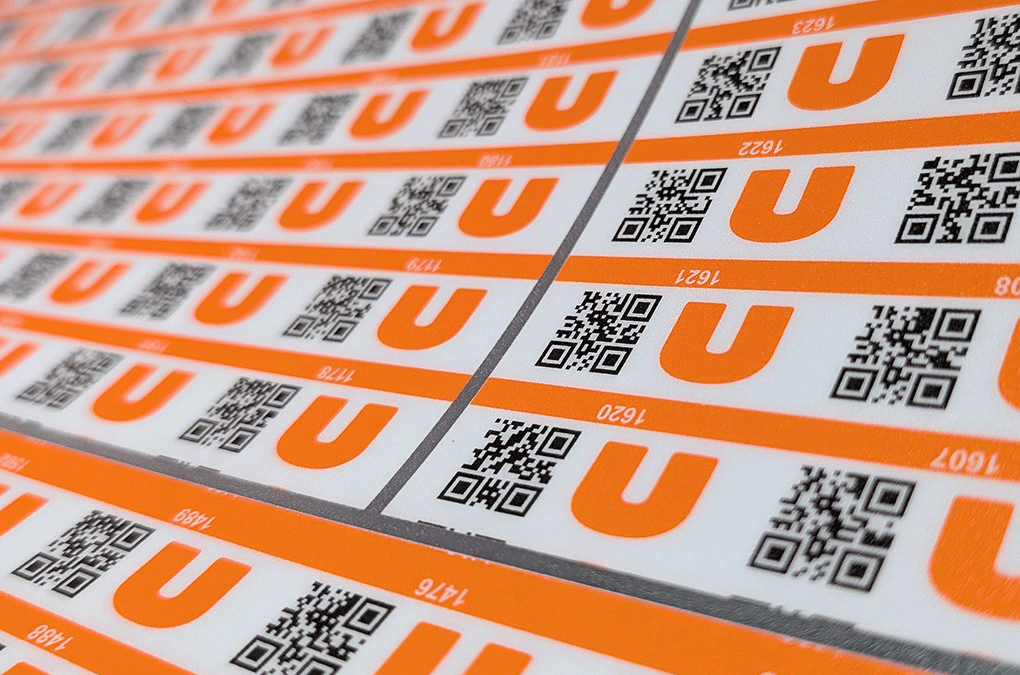
Buying an asset label isn't like buying a sticker. Here's why getting it right matters more than most organisations realise.
When organisations think about asset labelling, the label itself often feels like the smallest decision in the process. It's a line item, a small cost compared to the asset it's going on, and it can feel like one label is much the same as another. In practice, the choice of label is one of the most consequential decisions in the whole asset management process, and getting it wrong is far more expensive than most people expect.
The real cost of the wrong label
A label that fails isn't just a label that needs replacing. It's a chain reaction.
Think about a five year asset life. If the label fails at month eighteen, that's not an isolated problem with one item. It means the asset can no longer be reliably matched to its record. Multiply that across an estate, and you're looking at a full relabelling exercise: walking the estate again, reconciling old IDs with new ones, updating the register, and re establishing the audit trail that connects the physical item to its history.
The labour cost of that exercise, the time spent locating assets, cross referencing records, applying new labels, and updating systems, typically dwarfs the original cost of the label many times over. A slightly more expensive label that lasts the full asset life isn't a premium purchase. It's the cheaper option once you account for what happens if it doesn't.
This is why the most useful question to ask before specifying any label isn't "how much does this cost?" It's: what conditions will this label face, and for how long does it need to survive them?
Matching the label to the environment
The right label depends entirely on where it's going and what it will be exposed to.
A label on a laptop in a climate controlled office has an easy life. A label on a piece of plant machinery, an outdoor enclosure, or a vehicle has to survive UV exposure, temperature swings, chemical contact, abrasion, and physical knocks, potentially for a decade or more.
This is why we make a clear distinction between asset labels and asset tags. Labels are typically thinner and more flexible: polyester, vinyl, or laminated film, and are well suited to internal environments. Tags are thicker and semi rigid: laminated polyester, polycarbonate, or anodised aluminium, built for external or high wear applications where the label needs to survive years of punishment.
Getting this distinction right isn't about spending more for the sake of it. It's about matching the specification to the job. A tag built for outdoor plant machinery is no more "premium" than a label built for office IT equipment; they're simply engineered for different conditions.
The print method matters just as much as the substrate. Many labels look durable, thick, laminated, well adhered, right up until the lamination lifts at an edge and moisture gets underneath the print. The print is the part that actually carries the information, and it's also the most vulnerable part of any label if it isn't properly protected.
Under surface printing solves this by applying the ink to the underside of a clear substrate, with the adhesive behind it. The substrate becomes the protective layer, and because the print is never exposed to the outside world, it can't be abraded, chemically attacked, or worn away. It's the most durable print method available, which is why our Ultimate Asset Tag and UltraTuff ranges are both built around it.
Surface preparation: the step that's easy to skip and expensive to ignore
Even the right label, correctly specified, can fail if it's applied badly, and this is one of the most common, and most avoidable, causes of early label failure.
The adhesive needs a clean, dry surface, at the right temperature, to form a proper bond. Oil, dust, and moisture all undermine adhesion. Low energy plastics, polyethylene and polypropylene in particular, are notoriously difficult to bond to and need a high tack adhesive rather than a standard one. Cold conditions, below around 10°C, can prevent standard adhesives from bonding properly at all. And once applied, a label needs 48 to 72 hours to reach full bond strength before the asset goes back into service.
None of this adds meaningful cost. It just needs to be planned for, and it's the difference between a label that lasts ten years and one that starts lifting within six months.
Building an asset register that actually works
A label is only half of the equation. Its entire purpose is to connect a physical item to a record, and that record is what makes the label useful.
A good asset register doesn't need to be complicated to start with. At a minimum, it should capture a unique asset ID, a description, the manufacturer and model, serial number, location, owning department, acquisition date and cost, condition, and the date of the last audit. A register that starts simple but is maintained consistently is far more valuable than a comprehensive one that quickly falls out of date.
The single biggest factor in whether a register stays accurate isn't the software behind it, it's ownership. The most common reason registers deteriorate is that responsibility for them is split across departments. Finance owns the financial register, IT owns the laptops, operations owns the plant, and items fall through the gaps between them. Naming one person, with a named deputy, who is explicitly responsible for the accuracy of the register as a whole is one of the most valuable things an organisation can do, regardless of what system they're using.
Register at the point of arrival, not later
The single most effective habit in asset management is also the simplest: register the asset the moment it arrives.
At acquisition, applying the label, recording its details against the register, photographing the asset, and filing the purchase documentation takes minutes. Doing the same thing six months later, once the paperwork has been filed away and the item has already moved location once or twice, takes considerably longer, and the resulting record is far less reliable.
This single habit is what prevents the gradual drift between records and reality that leads to lost or unaccounted for assets: items that exist on the register but can no longer be located, or items that exist in reality but were never registered at all. Industry estimates suggest that between 10% and 30% of assets in unmanaged estates fall into this category. That has real consequences: insurance premiums paid on equipment that's no longer there, capital allowance claims resting on records that no longer reflect what's on site, and audits that take longer and carry more risk because the register can't be relied on.
Addressing this properly once, through a first full audit that reconciles the register against what's physically present, is far less costly than letting the gap widen year after year.
About Custom Labels Ltd
For 30 years, we've been manufacturing high quality asset labels and tags from our base in Somerset, working with organisations across manufacturing, logistics, healthcare, education, facilities management, and the public sector, from single site businesses managing a modest IT estate to large, multi site organisations with complex asset tracking needs.
We manufacture everything in house in the UK, hold ISO 9001 and ISO 14001 accreditation, and supply directly, which means tighter quality control, faster resolution if anything needs adjusting, and a team that responds to every enquiry individually.
If you're specifying labels for a new project, reviewing an existing estate, or just want to talk through what's right for your situation, we're happy to help, and we can send samples before you commit to an order. Visit customlabels.co.uk or call 01278 433800.
Recent Comments