

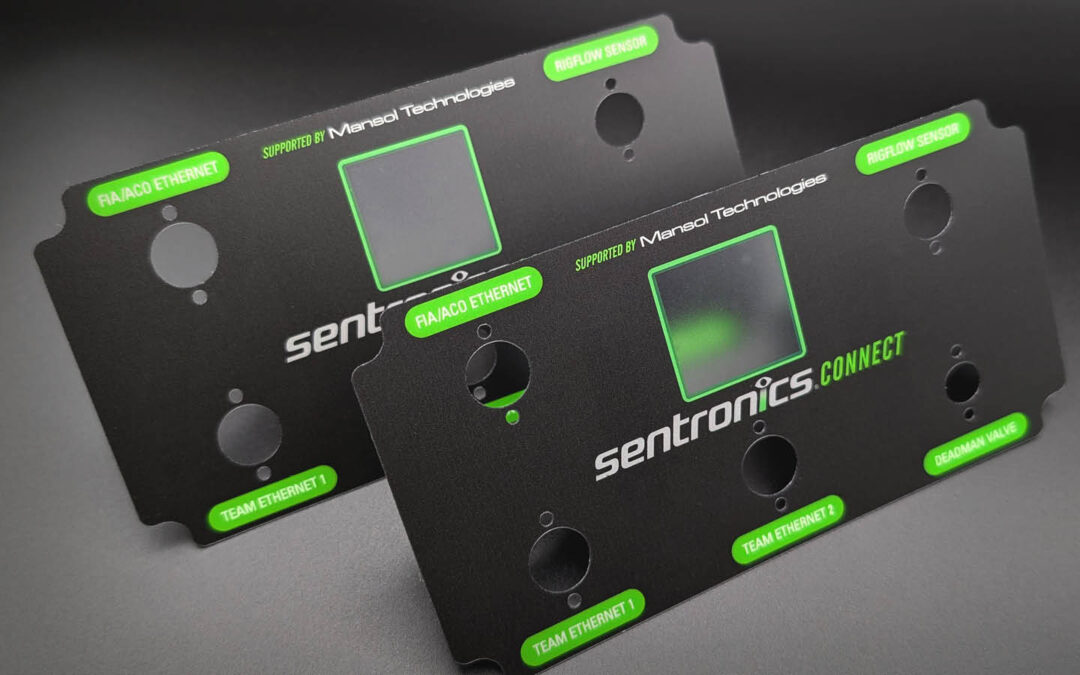
Developing a graphic overlay for a new product or piece of equipment involves more decisions than most people expect the first time they go through the process. Get those decisions right early and the path from initial concept to finished overlay is straightforward. Get them wrong and you can find yourself reprinting, re-specifying, or worse, launching with a front panel that does not perform the way you need it to.
This guide is for product developers, engineers, and OEMs who want to understand the full development process before they start, so they can move through it efficiently and arrive at the right result first time.
Start with the application, not the artwork
The most common mistake in graphic overlay development is treating it as a design exercise from the outset. Artwork matters, but the specification has to come first. Before any design work begins, the key questions are practical ones.
What environment will the overlay operate in? Will it be exposed to UV light, chemical cleaning agents, moisture, or significant temperature variation? What level of abrasion resistance does it need? How will users interact with it, and does it need tactile feedback through embossed buttons or textured areas? Are there windows or display cut-outs that need to be incorporated?
The answers to those questions determine the material, the finish, the construction method, and the print process. Getting that foundation right means the artwork that follows will work for the application rather than simply look good in isolation.
How the printing process shapes your options
Understanding how your overlay will be printed matters more than most customers realise at the start of a project. Plate-based printing methods such as screen or flexographic printing require physical plates to be produced for each colour in a design. Those plates carry a setup cost that applies regardless of how many overlays you are ordering. For small runs or prototype quantities, that cost makes genuine iteration prohibitively expensive in practice.
Digital printing removes that constraint entirely. Because artwork goes straight from file to output with no plates involved, there is no setup cost tied to your design and no penalty for making changes between runs. That has a direct effect on how you can approach development.
Why prototyping properly saves money in the long run
With digital printing, prototyping is genuinely accessible. You can order a small quantity of overlays to test against your hardware before committing to a full production run. That means checking fit, finish, colour accuracy, tactile response, and how the overlay sits against any adjacent components.
If something needs adjusting, you update the artwork file and reprint. There is no additional tooling cost and no minimum order penalty. In practice this means you can iterate properly rather than compressing your review process to avoid reprinting costs. The overlays that reach production have been physically tested and signed off rather than approved from a screen.
This is particularly valuable for OEMs managing multiple product variants. Each variant can be ordered in the quantity it actually requires rather than consolidated into larger runs to make the economics work.
Getting the artwork right
Artwork for graphic overlays has specific requirements that differ from standard print design. Colours need to be specified correctly for the substrate and finish being used. Cut-outs, apertures, and window areas need to be accurately defined. Embossed areas and button positions need to be incorporated into the design file in a way that translates correctly to the finished overlay.
If you come to us with finished artwork, we will check it against your specification before going to print. If you are earlier in the process and do not yet have a finished design, we can develop artwork from scratch. Many customers find it more efficient to work through the specification and artwork together rather than treating them as separate stages.
Scaling from prototype to production volume
One of the practical advantages of digital printing is that the process is consistent across quantities. The overlay you approve at prototype stage is produced using the same process as your full production run. There is no quality variation between a short run and a high volume order and no re-qualification needed when you scale up.
For manufacturers producing mature, high-volume products, that consistency matters as much as it does at the development stage. Colour accuracy, dimensional consistency, and material performance are the same whether you are ordering fifty overlays or five thousand.
What to bring to a first conversation
You do not need finished artwork or a complete specification to start a conversation with us. The most useful things to bring are a clear description of the application and environment, a sense of the quantities involved across your development and production phases, and any specific performance requirements such as chemical resistance ratings or industry standards the overlay needs to meet.
If you have panel drawings or dimensional diagrams showing cut-out positions, button layouts, and tolerances, our in-house design team can work from those directly to produce print ready artwork. You do not need to supply finished design files. Many customers find it more efficient to hand the artwork stage to us entirely, knowing the output will be built to the correct specification from the start rather than needing conversion or correction before it can go to print.
From there we can work through the full specification with you, advise on materials and construction, and provide a quotation. If you would like to evaluate our materials and finishes before committing to anything, we can send a graphic overlay sample booklet on request.
Recent Comments