

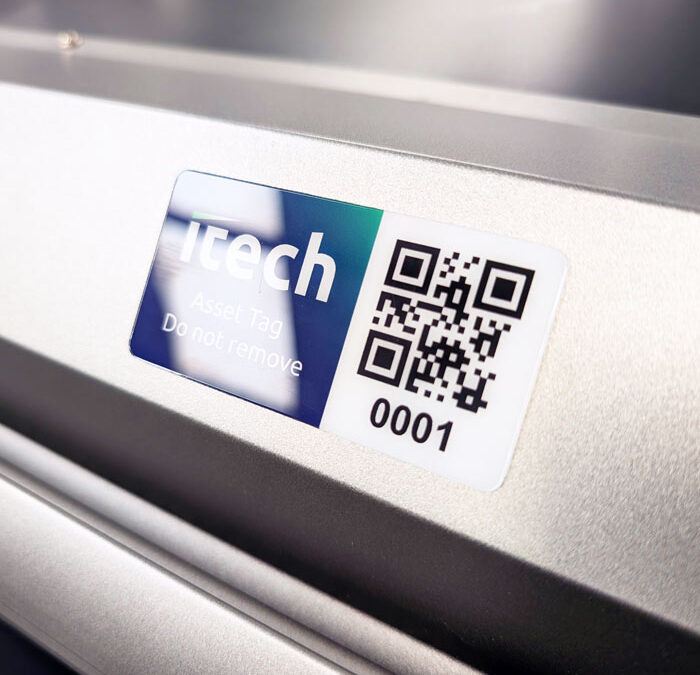
Walk around most industrial sites and you'll find asset tags that were sold as heavy duty, now scratched through, faded, or peeling at the edges within a couple of years.
In most cases, the issue is the same: a laminated polyester label.
This isn't a marketing claim it's a materials problem. Below, we explain exactly why laminated polyester fails in demanding environments, where it genuinely excels, and what a true heavy-duty alternative looks like.
Laminated polyester asset tags are marketed as "ultra durable" but are engineered primarily for indoor use. Their weak point is the edge of the laminate film, which can lift under flexing, abrasion, or chemical exposure letting moisture underneath and causing the print to fade or peel. For genuinely harsh environments (marine, aviation, heavy machinery, outdoor plant), a solid polycarbonate tag with the print sealed beneath the surface rather than laminated on top is the more durable option.
Why "Ultra Durable" Polyester Asset Tags Fail
Polyester isn't a bad material it's a genuinely solid, cost-effective choice for indoor IT equipment and office assets, and it's a product Custom Labels sells ourselves.
The problem is when polyester tags are marketed as suitable for environments they were never engineered to survive: external plant, marine equipment, and heavy machinery.
Here's the mechanism behind the failure:
- The construction is a coating, not a barrier. A laminated polyester tag consists of a printed layer with a protective laminate film applied on top.
- The edge is the weak point. On curved or flexing surfaces, the laminate film can lift or peel at the edges.
- Moisture gets underneath. Once the seal breaks, moisture, chemicals, and abrasion reach the print layer directly.
- The result is visible within one to two years: scratched-through, faded, or peeling labels, even on tags originally sold as heavy duty.
Where Laminated Polyester Tags Still Make Sense
Polyester tags remain a strong, cost-effective choice for:
- Indoor IT equipment (servers, laptops, networking hardware)
- Office equipment and furniture
- Low-exposure indoor asset tracking
The issue isn't the material itself it's mismatching it to conditions it wasn't designed for.
Introducing the Ultimate MAX Asset Tag™: 500 Microns of Sealed Polycarbonate
To close the durability gap properly, Custom Labels has launched the Ultimate MAX Asset Tag™.
How It's Built
Ultimate MAX takes our existing Ultimate construction 250-micron polycarbonate with the graphic printed beneath the surface rather than on top and doubles the thickness to 500 microns.
Because there is no exposed print layer, there's nothing for abrasion, chemicals, or aggressive cleaning to strip away. The polycarbonate itself is the protection not a coating sitting on top of it.
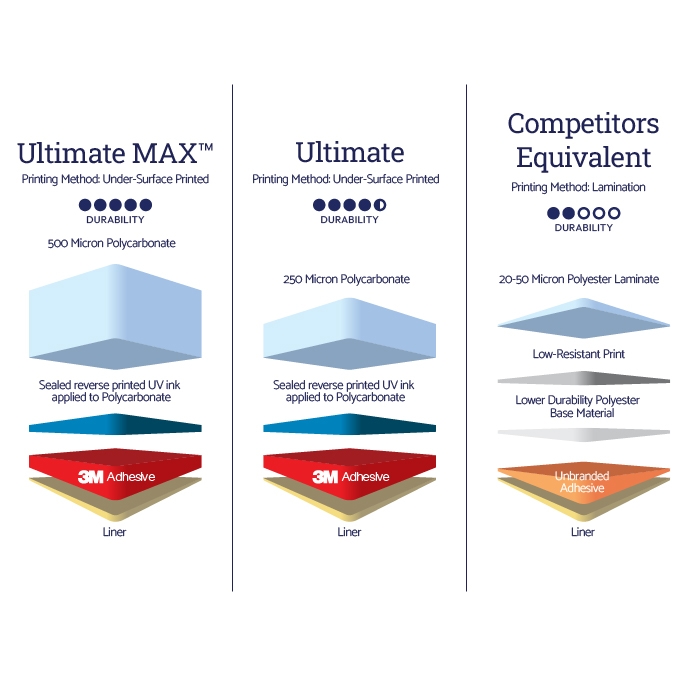
At 500 microns, this is the thickest, most abrasion-resistant non-metal tag Custom Labels has produced built for aviation, construction, utilities, manufacturing, and marine environments, exactly the conditions where standard tags, and most competitors' "ultra durable" polyester ranges, tend to fail first. It's rated for resistance to UV exposure, chemicals, aggressive cleaning, and saltwater.
Specification snapshot:
- Thickness: 500-micron polycarbonate (double the standard Ultimate)
- Print method: Under-Surface Printing (sealed beneath the polycarbonate, not laminated on top)
- Finish options: High Gloss or Textured Velvet polycarbonate
- Adhesive: High-performance 3M™ acrylic adhesive (60-micron or 130-micron, depending on surface), cures over ~72 hours to form a permanent bond
- Surface suitability: Flat surfaces only due to its thickness and rigidity, it is not designed for curved applications
- Pricing: From £250.47 ex. VAT (£300.56 inc. VAT)
Because it's rigid rather than flexible, Ultimate MAX is best matched to flat panels, housings, and machine bodies — not curved pipework or rounded equipment, where the standard Ultimate or a flexible material may be the better fit.
Don't Need MAX? The Original Ultimate Is Still Hard to Beat
For assets facing serious wear but not the absolute extremes, the standard Ultimate Asset Tag™ (250-micron polycarbonate, under-surface printed) remains our most popular heavy-duty option and still outperforms most suppliers' top-tier polyester products.
Frequently Asked Questions
Why do "ultra durable" asset tags fail so quickly? Most are laminated polyester with the print applied under a protective film. In outdoor, marine, or heavy machinery environments, the film can lift at the edges especially on curved or flexing surfaces letting moisture in and causing the print underneath to fade or peel.
What makes the Ultimate MAX Asset Tag different? It's made from 500 microns of solid polycarbonate with the graphic printed beneath the surface rather than laminated on top. There's no exposed print layer for abrasion, chemicals, or aggressive cleaning to strip away.
Is polyester a bad material for asset tags? No. Polyester is a solid, cost-effective choice for indoor IT equipment and office assets. It becomes a problem only when marketed for outdoor, marine, or heavy-machinery use it wasn't engineered to survive.
Do I always need the thickest, most durable tag available? No. The right choice depends on what the asset is actually exposed to. The standard Ultimate Asset Tag (250 microns) suits serious wear; Ultimate MAX (500 microns) is for the most extreme environments, such as aviation, marine, and heavy construction.
What industries is the Ultimate MAX Asset Tag designed for? Aviation, construction, utilities, manufacturing, and marine environments, sectors where standard tags and typical "ultra durable" polyester ranges tend to fail first.
Can the Ultimate MAX Asset Tag be used on curved surfaces? No. Due to its thickness and rigidity, Ultimate MAX is designed for flat surfaces only. For curved or contoured equipment, the standard Ultimate Asset Tag (250 microns) is the more suitable option.
See the Difference for Yourself
If your current tags are letting you down, or your application demands the most durable polycarbonate asset tag on the market, it's worth seeing what 500 microns actually looks like.
Recent Comments