

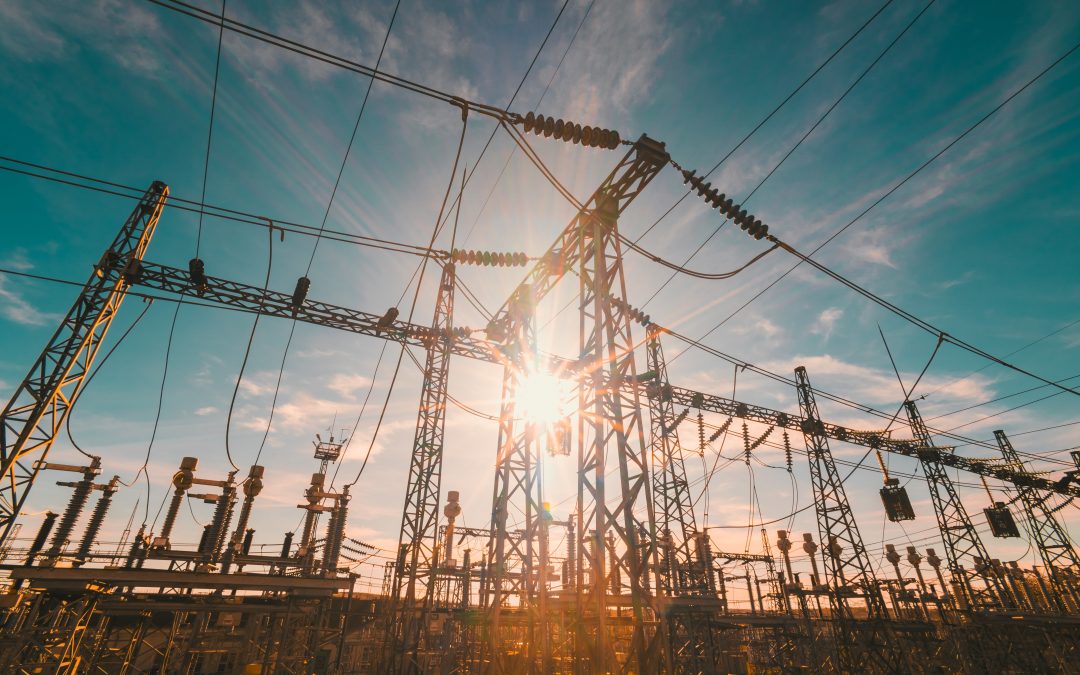
From our factory in Bridgwater, you can follow the entire national argument about electricity without leaving the county.
Drive one way and you reach Hinkley Point C, where Britain is building new nuclear capacity at a scale it has not attempted in decades. Drive the other and you reach the Gravity site at Puriton, where a £4 billion battery gigafactory is waiting on the power lines that will feed it. In between, the roads have been dug up for months to lay the connection between the two ideas.
Meanwhile, three hundred miles away, the same conversation is playing out in a form that has started to make national news. The question is no longer whether Britain wants industrial investment. It is whether there is enough electricity to connect it.
The Generation Side
Hinkley Point C is the most visible part of the story, and this autumn it passed another milestone when the dome was lifted onto the second reactor. The project has been built on a principle its own team call build and repeat, and the figures bear it out, with innovation and experience gained at Hinkley expected to benefit Sizewell C from the start.
The second unit has gone up materially faster than the first. The pressure vessel installation was reached up to 30% faster than on Unit 1. Elsewhere on site, crews finished digging a 620 metre tunnel under the Bristol Channel for the station’s fish return system, one of the parts of the project that rarely makes headlines but took years to design.
When it runs, Hinkley Point C will provide zero-carbon electricity for around six million homes, and it is described as a £13 billion boost for the British economy. It has also attracted sustained criticism over rising costs and schedule delays, which is a fair part of the record and worth stating plainly rather than skipping past.
The Demand Side
A few miles north, the Agratas gigafactory represents the other half of the equation, and it has a far shorter timescale.
Work to supply the site with power has been ongoing since September, with significant roadworks around Bridgwater as high voltage lines go in. Somerset Council has held public drop-in sessions about it, acknowledging that this is a busy period on the local network and asking for patience.
For anyone living here, this is the least glamorous part of industrial strategy. It is temporary lights on the way to work. But it is also the bit that actually determines whether an investment of this scale happens, and it is the bit that is hardest to accelerate.
A battery factory is an enormous electrical load. Building the factory is a construction problem with a known solution. Getting the power to it is a different kind of problem entirely, involving landowners, consents, physical cable routes and a grid that was designed around a different industrial map.
The National Version of the Same Problem
What makes this more than a local story is that the country has now hit the same wall, in a sector moving far faster than either nuclear or automotive.
The government estimates that the UK will need 6GW of AI data centre capacity by 2030, around three times the country’s total data centre estate today, most of which was not built for AI compute. The investment to build it largely exists. The electricity to run it does not.
The clearest illustration came recently when Microsoft withdrew from plans to develop what would have been Britain’s largest AI data centre, alongside London-based Nscale, after grid capacity problems prevented the Essex site from securing power in time for its planned launch. That is not a funding failure or a planning failure. It is a connection failure.
The Chancellor’s response in the Autumn Budget was the British Data Centre Covenant, which offers developers priority access to the electricity grid, and permission to build on-site generation while they wait, in exchange for commitments on jobs, communities and environmental protections.
Read that alongside what is happening in Bridgwater and the shape of the decade becomes clear. The constraint on British industrial growth is no longer capital or ambition. It is the wire.
What This Looks Like From a Somerset Factory Floor
We are a label manufacturer. We are not going to pretend to expertise in grid policy, and this is a perspective from nearby rather than a technical analysis.
But there is something worth saying from where we sit, which is that we have watched both of these projects from a few miles away for years now, and the thing that strikes us most is the gap between how these schemes are discussed nationally and what they actually consist of.
Nationally, they are figures. Four billion pounds. Six million homes. Six gigawatts by 2030.
Locally, they are a tunnel under the Bristol Channel, a crane lift that takes an hour and was planned for months, a cable trench along the Bath Road, and several thousand people who need somewhere to park. Infrastructure at this scale is not one decision. It is tens of thousands of small ones, each of which has to be recorded, checked and found again later by somebody who was not there when it was made.
The Part We Supply
That last point is where our own work comes in, and it is a bigger part of these projects than most people would guess.
Every valve, panel, cable run, cabinet and piece of plant on a site like Hinkley carries an identifier, and that identifier has to remain readable for decades, long after the people who installed it have moved on. It is the least interesting component of a nuclear power station, and it is the one that makes the rest of it maintainable.
We supplied Balfour Beatty with our UltraTuff asset tags for use at Hinkley Point C, chosen for their resistance to abrasion, chemicals and general abuse, and for how well they perform outdoors. The specification conversation was about what would still be legible in twenty years, which is a different question from what looks good on delivery.
Since then we have taken that range further. Our Ultimate Asset Tag uses 250 micron polycarbonate with the graphic printed beneath the surface rather than laminated on top, so there is no exposed print layer for abrasion or industrial cleaning to strip away. Ultimate MAX doubles that to 500 micron, with a service temperature range of minus 40°C to plus 160°C, resistance to UV, saltwater and industrial cleaning agents, and 3M 200MP high performance acrylic adhesive. It is the thickest and most abrasion resistant non-metal tag we produce.
The same requirement runs through every part of this story. A gigafactory needs plant and equipment identification from the day the first machine is installed. A data centre needs asset tags, cable labels and port identification at a density higher than almost any other environment, and now carries Critical National Infrastructure expectations on top. Everything we make for these projects is manufactured here in Bridgwater, in house, under ISO 9001 and ISO 14001, within a few miles of the sites themselves.
Somersets' Quietly Growing Tech Industry Hub
Somerset is not usually where you look for the future of British industry. It is a county of levels and cider and a carnival, and Bridgwater has spent most of its modern history being somewhere people drive past on the M5.
That has changed, quietly and without much national notice. Within about fifteen miles of our factory, the country is simultaneously building its largest source of new generation and one of its largest single industrial loads, and connecting the two. Whether that works out is going to tell you a good deal about whether the rest of the plan does.
Frequently Asked Questions
Why is grid capacity limiting UK investment? Large industrial and data centre projects need connections to the electricity network, and in many areas available capacity has been allocated or requires reinforcement. Securing a connection can take longer than building the facility itself.
What is the British Data Centre Covenant? Announced in the Autumn Budget 2026, it offers data centre developers priority grid connections and the ability to build on-site generation while waiting, in return for commitments on jobs, communities and environmental protections.
What stage is Hinkley Point C at? The dome has been lifted onto the second reactor and the second pressure vessel is installed, with the project applying a build and repeat approach intended to carry efficiencies into Sizewell C. The project has also faced reported cost increases and delays.
Why are there roadworks around Bridgwater? Work to supply power to the Agratas battery facility has been ongoing since September, involving high voltage lines and significant works on the local road network.
What asset tags are suitable for energy and infrastructure projects? Durable under-surface printed tags are the usual choice, where the print sits beneath the substrate rather than under a laminate. Our UltraTuff tags have been used at Hinkley Point C, while Ultimate and Ultimate MAX offer 250 and 500 micron polycarbonate for the most demanding environments.
Where is Custom Labels based? We have manufactured labels and asset tags in Bridgwater, Somerset since June 1997, with all production in house under ISO 9001 and ISO 14001 accreditation.
Talk to Us
If you are working on a major project in the South West or supplying into one, and you need identification that lasts the life of the asset, our team is happy to help. Call 01278 433800, email sales@customlabels.co.uk, or order a sample pack to test on your own surfaces.
Recent Comments